





Written by:

Medically Reviewed by:
Last Updated:
August 13th, 2026
Cannabis rehab
Cannabis addiction is one of the most subtle. There is no overdose, no cardiac arrest, no dramatic collapse that forces the issue at hand. Instead, it works by subtraction. It removes ambition so gradually that the person barely notices it leaving. It subtracts emotional depth, replacing the full spectrum of human feeling with a narrow, muted band of okay-ness, and it subtracts years that the person cannot account for because they were spent in a haze that felt comfortable at the time.
By the time someone considers cannabis rehab, they are usually in a long, quiet stall. Life has simply stopped moving. The career that should have progressed has plateaued, the relationships that should have deepened remain shallow, and the interests that should have expanded have narrowed to the drug and the rituals that surround it.
Cannabis rehab is the process that addresses the cannabis detox process, the psychological dependence that sustains daily use, the emotional and developmental gaps that the drug has created, and the practical work of building a life that is genuinely lived rather than observed through a pharmacological fog.
The Problem with Being Comfortable
Most substances of addiction are associated with obvious harm. For example, heroin destroys the body, alcohol destroys the liver, crack cocaine destroys everything at once, but cannabis does something subtler and, in its own way, can be more insidious…it makes the person comfortable with a life that is significantly less than what they are capable of.
This is why cannabis addiction is so difficult to treat, and why the cultural perception that it is a harmless drug is so damaging. The person is not suffering enough, by their own assessment or anyone else’s, to justify the disruption of treatment. They are functioning, but the distance between where they are and where they could be is growing wider every year.
Rehab begins with the recognition that comfort is not the same as being healthy and well. This recognition is the hardest part, and it is often the reason people delay treatment. Cannabis rehab does not require the person to be in crisis, it requires them to be honest about the gap between the life they are living and the life they want.
A conversation can change
everything
Taking the first step, and acknowledging your Cannabis dependency is the hardest part. Call us today, and speak with a member of our team in complete confidence, who understands firsthand the challenges of addiction.
What Cannabis Quietly Replaced
Understanding what cannabis has taken is the first step in understanding what recovery can restore. Effective rehabilitation does not simply remove the drug; it identifies and rebuilds the capacities and experiences that the drug displaced. For most long-term cannabis users, these fall into recognition.
Rehabilitation rebuilds emotional range and resilience. This is not a comfortable process, as the emotions that resurface during and after cannabis withdrawal can feel overwhelming precisely because the person has had no practice managing them. Anger, grief, anxiety, excitement, love, frustration: everything arrives at full volume after being diluted for so long. The therapeutic programme provides the skills, the support, and the safe environment needed to tolerate this emotional awakening and to develop the capacity to regulate it independently.
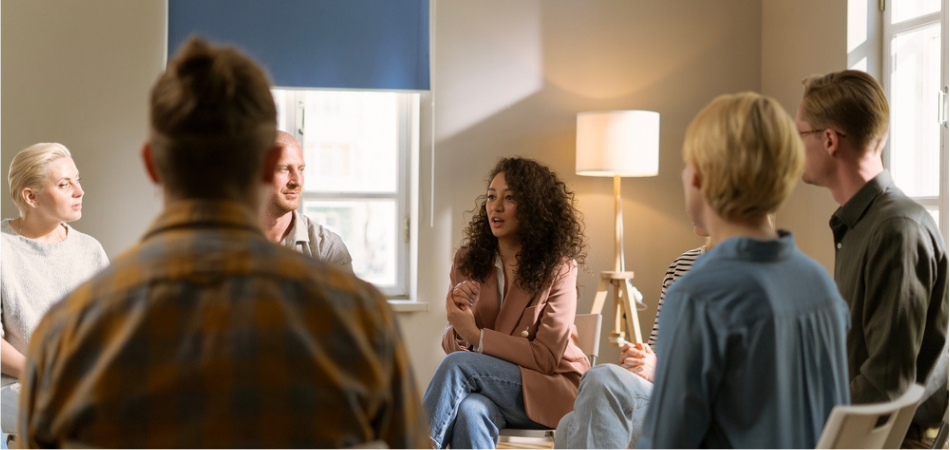
Rehab addresses this directly. The residential therapeutic community provides an experience of connection that is qualitatively different from anything the person has known during active use: honest, emotionally present, mutually supportive, and built on shared vulnerability rather than shared intoxication. Group therapy teaches the interpersonal skills that cannabis-mediated socialising never required: listening, being honest, tolerating disagreement, expressing needs, and sitting with someone else’s pain without reaching for an escape.
Cognitive recovery is one of the most tangible and motivating aspects of cannabis rehabilitation. The structured, cognitively demanding environment of the therapeutic programme, with its daily sessions, group discussions, and reflective exercises, actively supports the brain’s recovery, and the individual’s capacity to engage with increasingly complex material improves visibly over the course of treatment.
The Therapeutic Work of Cannabis Rehab
Cannabis rehab at Banbury Lodge is structured around the recognition that cannabis dependence is primarily a psychological and behavioural condition. The therapeutic programme is therefore intensive, psychologically focused, and oriented towards building the internal capacities that cannabis use has prevented from developing.

The Developmental Gap
The right cannabis rehab must address a dimension of the addiction that is often overlooked: the developmental impact of early-onset use. The adolescent brain is still forming, particularly the prefrontal cortex, which governs decision-making, impulse control, emotional regulation, and the ability to plan for the future. Cannabis use during this critical developmental window disrupts the maturation of these capacities, and the individual may arrive at treatment in their twenties or thirties with the emotional regulation skills, the stress tolerance, and the coping repertoire of the teenager they were when they started using.
The skills that most people acquire through the normal stresses and challenges of adolescence and early adulthood, navigating conflict, managing disappointment, delaying gratification, tolerating boredom, maintaining effort, were never fully developed because cannabis provided a bypass. Rehabilitation, in a real sense, picks up the developmental work where the drug interrupted it: teaching, practising, and consolidating the life skills that were missed.
Cannabis, Mental Health, and the Self-Medication Trap
Depression, anxiety, ADHD, PTSD, and psychotic disorders are all significantly overrepresented among individuals with cannabis dependence. The relationship is complex: cannabis may have been used to self-medicate a pre-existing condition, may have worsened or precipitated a condition, or may have done both simultaneously. The self-medication trap, in which the drug temporarily relieves the symptoms of a condition that it is simultaneously worsening, is one of the most clinically significant patterns in cannabis addiction.
At Banbury Lodge, cannabis rehab is delivered through an integrated dual diagnosis framework. Psychiatric assessment, mental health monitoring, and appropriate treatment are woven into the programme from the outset. For individuals at risk of cannabis-related psychosis, careful monitoring during and after withdrawal is essential. For those with underlying anxiety or depression that cannabis was masking, accurate diagnosis and the establishment of effective, non-cannabis treatment is often the difference between sustained recovery and relapse.
Navigating a World Full of Cannabis
Cannabis is the most widely used illicit substance in the UK. It is offered at parties, smoked openly in parks, discussed casually on social media, and normalised in popular culture to a degree that no other controlled drug approaches. The person leaving cannabis rehab re-enters a world in which the drug is not merely available but culturally endorsed. Relapse prevention must reckon with this reality.
The plan developed during rehabilitation addresses:
- Trigger mapping: A comprehensive inventory of the specific people, places, times, emotions, and situations that have historically triggered cannabis use. For daily users, the trigger list is often extensive: waking up, finishing work, feeling bored, feeling stressed, being alone, being in company, watching television, listening to music. The plan identifies each trigger and attaches a specific, rehearsed alternative response.
- Social network decisions: Honest assessment of which friendships can survive the removal of cannabis and which cannot. Concrete plans for managing social situations where cannabis is present. Development of new, recovery-supportive social connections.
- The boredom plan: Cannabis fills time. It makes empty hours tolerable. Removing it leaves a void that must be actively filled. The relapse prevention plan includes a concrete, practical list of activities, commitments, and routines that structure the individual’s time in early recovery, because unstructured time is the single most reliable predictor of relapse for cannabis-dependent individuals.
- Emotional management toolkit: The specific CBT strategies, mindfulness techniques, and self-regulation skills the individual has found most effective during treatment, documented for use when emotions or cravings escalate
- Sleep strategy: A detailed plan for managing the insomnia and vivid dreams that characterise cannabis withdrawal and can persist for weeks, including sleep hygiene practices, non-addictive pharmacological support where needed, and the reassurance that sleep does normalise with time
- Lapse protocol: A written plan for what to do if a single episode of use occurs, designed to prevent it from becoming a return to daily use
Cannabis Rehab at Banbury Lodge
We understand how easy it is to question whether your cannabis use is “serious enough” for treatment, but if it is affecting your mental health, relationships, work, or quality of life, you deserve support.
At Banbury Lodge, we provide compassionate, evidence-based treatment tailored to your individual needs. Your programme begins with a comprehensive assessment of your cannabis use, mental health, personal circumstances, and recovery goals, allowing us to build a treatment plan that addresses the whole person, not just the addiction. Through individual and group therapy, dual diagnosis support, relapse prevention planning, and holistic wellbeing therapies, we help you understand the underlying causes of cannabis dependence and develop the skills to build a healthier, more fulfilling life.
Recovery does not end when residential treatment finishes. As your thinking becomes clearer, motivation returns, and daily life begins to feel more manageable, new challenges can emerge. Our comprehensive aftercare programme provides ongoing therapy, key-working, family support, psychiatric follow-up where needed, and connections to peer support networks, helping you maintain your recovery with confidence long after you leave our care.
Cannabis addiction can convince you that everything is fine. Recovery allows you to discover how much more life has to offer. If you’re ready to take that first step, our team is here to help.
Expert, personalised Cannabis treatment at every stage of your recovery
From your first conversation through to aftercare, we provide structured, evidence-based support throughout every stage of recovery. Help is available when you are ready.
Frequently asked questions
If you are worried about a loved one’s cannabis use and want to convince them to consider rehab, here are some tips that may help:
- Express your concern
- Choose the right time and place
- Listen to their perspective
- Share information about the potential risks of long-term cannabis use
- Offer support
- Frame the idea of rehab positively
- Be patient- change takes time
(Click here to see works cited)
- American Psychiatric Association (2013). Diagnostic and Statistical Manual of Mental Disorders (5th ed.). Arlington, VA: APA.
- Budney, A. J., et al. (2004). Review of the validity and significance of cannabis withdrawal syndrome. American Journal of Psychiatry, 161(11), 1967–1977.
- NHS (2024). Drug addiction: getting help. NHS.uk.
- National Institute on Drug Abuse (NIDA) (2021). Cannabis (Marijuana) DrugFacts. U.S. Department of Health and Human Services.
- National Institute for Health and Care Excellence (NICE) (2007, updated 2021). Drug misuse in adults: CG51 and CG52. NICE.
- Di Forti, M., et al. (2019). The contribution of cannabis use to variation in the incidence of psychotic disorder across Europe (EU-GEI). The Lancet Psychiatry, 6(5), 427–436.
- Freeman, T. P., & Winstock, A. R. (2015). Examining the profile of high-potency cannabis and its association with severity of cannabis dependence. Psychological Medicine, 45(15), 3181–3189.
- Meier, M. H., et al. (2012). Persistent cannabis users show neuropsychological decline from childhood to midlife. PNAS, 109(40), E2657–E2664.
- Carroll, K. M., & Onken, L. S. (2005). Behavioral therapies for drug abuse. American Journal of Psychiatry, 162(8), 1452–1460.
- McHugh, R. K., et al. (2010). Cognitive behavioral therapy for substance use disorders. Psychiatric Clinics of North America, 33(3), 511–525.
- Volkow, N. D., Koob, G. F., & McLellan, A. T. (2016). Neurobiologic advances from the brain disease model of addiction. New England Journal of Medicine, 374(4), 363–371.
- Bonnet, U. (2020). The cannabis withdrawal syndrome: current insights. Substance Abuse and Rehabilitation, 11, 53–66.
- Advisory Council on the Misuse of Drugs (ACMD) (2008). Cannabis: Classification and Public Health. ACMD.

